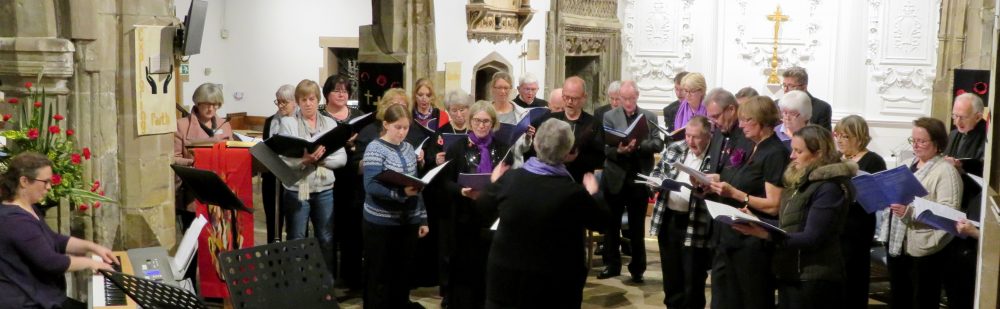
It was great to see some of you last Friday. Once again I apologise for the technical mishap. I have since used zoom twice more with no trouble so it augers well for the A.G.M. on 20th November.
Over the next few weeks our technical work will refresh one aspect of singing. The first one this week is on Posture.
After compiling the last Nick’s Notes it occurred to me that we have two further settings of Ave Verum in our repertoire by Mozart and Saint-Saëns which we will look at this week. Neither of these two settings include the O Dulcis section of the text and were composed for liturgical use (i.e. in the context of a church service).
I have selected recordings by German and French choirs respectively so that you can hear pronunciation differences. Latin is an extinct language so each country has developed its own conventions and accent. In this text there are not many moments of controversy (the letters ‘c’, ‘g’ and diphthongs provoke the most). The main variation that I notice is the ‘e’ vowel – the second word verum is a notable example.
Let’s look at Mozart’s setting first:
European Sacred Music page 248.
From Wikepedia: “Mozart composed the motet in 1791 in the middle of writing his opera Die Zauberflöte.[1] He wrote it while visiting his wife Constanze, who was pregnant with their sixth child and staying in the spa Baden bei Wien.[1] Mozart set the 14th century Eucharistic hymn in Latin “Ave verum corpus“. He wrote the motet for Anton Stoll, a friend of his and of Joseph Haydn.[2] Stoll was the musical director of the parish St. Stephan, Baden.[3] The setting was composed to celebrate the feast of Corpus Christi; the autograph is dated 17 June 1791. (The Feast of Corpus Christi falls on the Thursday following Trinity Sunday, and in 1791 was observed on June 23.) The composition is only forty-six bars long and is scored for SATBchoir, string instruments, and organ. Mozart’s manuscript contains minimal directions, with only a single sotto voce marking at the beginning. The motet was composed less than six months before Mozart’s death.[2] It foreshadows “aspects of the Requiem such as declamatory gesture, textures, and integration of forward- and backward-looking stylistic elements”.[4] While the Requiem is a dramatic composition, the motet expresses the Eucharistic thoughts with simple means, suited for the church choir in a small town.[2][5] “
It is a simple, homphonic composition that is basically a harmonised melody. It would work as a song with just the soprano part and accompaniment. As is typical with Mozart there is plenty of room for expressive, lyrical singing.
The Saint-Saëns setting is in the purple booklet with Elgar Happy Eyes and Serendade or here.
Saint-Saëns lived from 1836-1921. Like Mozart he was a child prodigy. He was organist at La Madeleine church for twenty years from 1858. It is thought that this motet was written about 1860. There are similarities to the Mozart setting in that it is homophonic, designed to be accompanied (although it does work unaccompanied) and could be an accompanied soprano solo.
I think that it is interesting to compare these settings of the same text spanning 300 years or so. It is difficult for me to pick a preference as they are all equally effective and written by composers who worked for the church but had many other musical irons in the fire. Mozart is more well known for his operas and symphonies; Saint-Saëns for orchestral music and Byrd for keyboard pieces. Which one is your favourite? (Answer in the comments below).
See you next week at the A.G.M.

